Wren Spinney School

Communication Skills
Functional communication is at the centre of all our curricular activities.
Activities are designed to engage and motivate students to participate, and a total communication approach has been adopted.
Speaking & Listening
Students’ attention and listening skills are supported in communication-friendly environments, where distractions are minimised and understanding is supported by the appropriate use of:
- Real-life objects
- Photos
- Symbols
- Sign Along signing
The Attention Autism approach also supports the development of attention and engagement.
Students are also given frequent opportunities to make choices and share their thoughts with others.
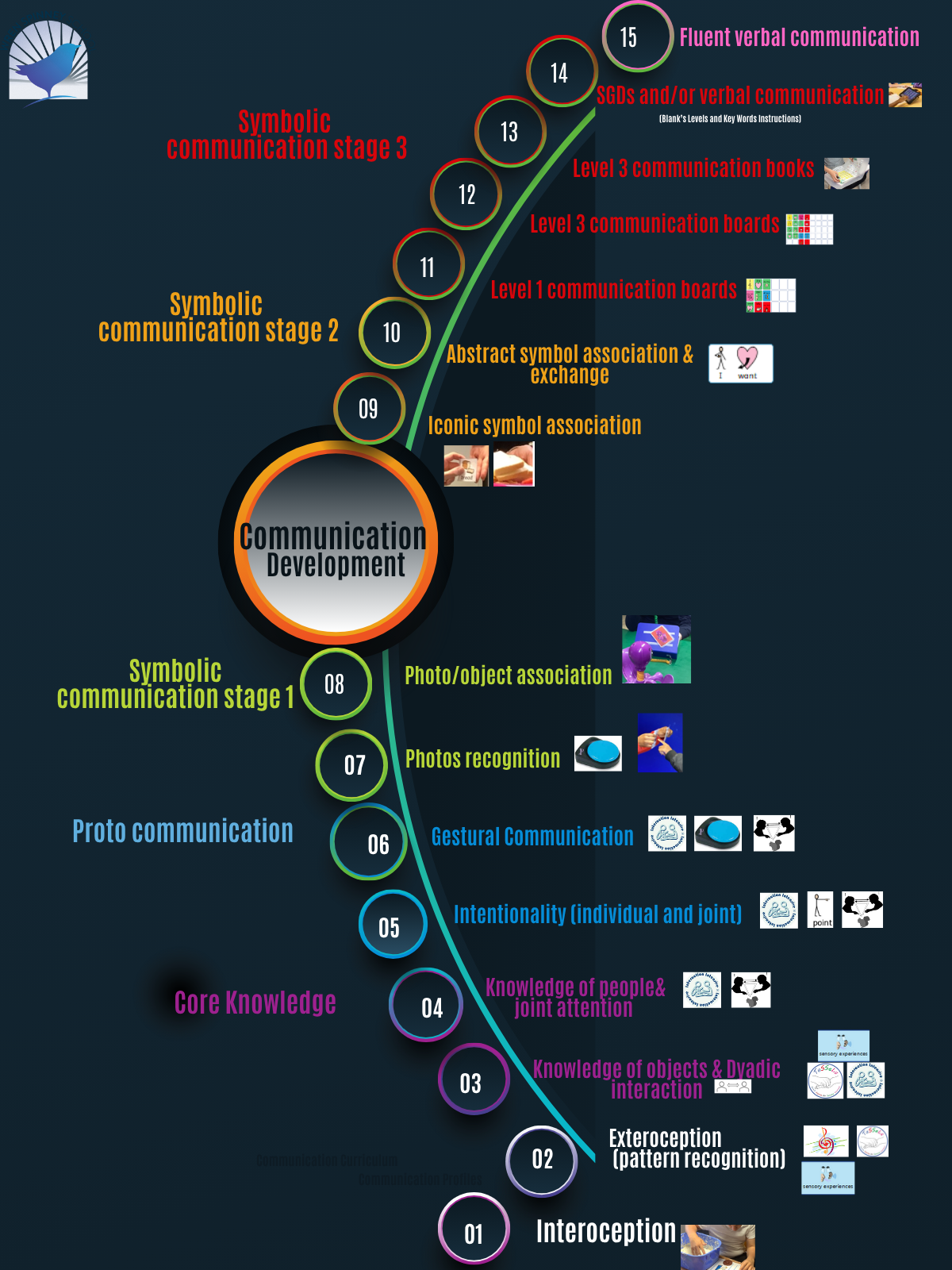
While some of our students are vocal communicators, others require the use of an Alternative and Augmentative Communication (AAC) system, which may include the use of:
- Objects of Reference (OoR)
- Aided language stimulation with communication boards and/or communication books.
- The Picture Exchange Communication System (PECS)
- Sign Along signs
Teachers work closely with our speech and language therapist to ensure that students’ communication goals are targeted, reviewed, and embedded into learning and communication opportunities throughout the school day.
Progress in functional communication enables our pupils to achieve a greater degree of independence and encourages stronger self-esteem.
Reading
Reading is provided at different levels:
Below Reading W11
For students who are working below Reading W11, the following strategies will be implemented to support reading:
- Augmented reading approach, which enables the students to read whole words.
- PECS including transition from OoR or Pictures to Symbols.
- Communication boards and books.
- Lanyard symbols to reinforce instructions.
- Exposure to rhythm, rhyme and alliteration is provided through “Call and Response” sessions.
- Develop play around favourite stories using props, encourage listening to stories with increasing attention and recall during sensory stories.
- Exposure to books and to favourite songs.
- Colourful semantics.
Above W11 Level
We believe that a systematic phonics programme is effective when offered to pupils above W11 Level (cognitive age of 3–4 years). Our students follow the Sounds Write programme, which is structured in three sections:
The Initial Code:
- Word Building – core lesson
- Symbol Search
- Sound Swap
- Reading and spelling words and dictation
- Introducing spellings with 2 letters
The Extended Code:
- One sound, different spellings – word puzzles
- One sound, different spellings – reading and writing
- Sound review
- Seek the sound
- One spelling, different sounds
Polysyllabic words are taught with lessons:
- Building polysyllabic words – sound level
- Reading polysyllabic words – sound level
- Building polysyllabic words – syllable level
- Reading polysyllabic words – sound/syllable level
- Analysing polysyllabic words
Writing
Students working above W11 are encouraged to write during their phonics sessions.
Students also choose to write during other sessions, such as:
- Online safety
- Sensory stories
- Enterprise
- Free play
- When creating storyboards just for fun.
During free play and arts and crafts, the students can choose to make marks using different tools. A variety of textures are provided to facilitate mark making and these can be: paint, semolina, flour, lentils, rice, sand etc.