Wren Spinney School

Relationships & Sex Education
The aims of Relationships and Sex Education (RSE) at our school:
- Provide a framework in which sensitive discussions can take place.
- Prepare pupils for puberty, and give them an understanding of sexual development and the importance of health and hygiene.
- Help pupils develop feelings of self-respect, confidence and empathy.
- Create a positive culture around issues of sexuality and relationships.
- Teach pupils the correct vocabulary to describe themselves and their bodies.
- Support families and students in any challenges that may arise relating to RSE.
- Support staff through their induction training and their continued development.
- Support students to form safe relationships and to safeguard students.
RSE is lifelong learning about physical, sexual, moral and emotional development.
It is about teaching sex, sexuality and sexual health in a way that gives students the confidence to make sound decisions when facing risks and other challenges. It includes:
- Teaching about friendship.
- The importance of caring, stable and mutually supportive relationships with another person.
- How to control and understand feelings that come with being in a relationship.
RSE does not encourage early sexual experimentation. It teaches children and young people:
- To understand human sexuality
- To respect themselves and others
- To build self-esteem
- To understand the reasons for delaying sexual activity
This will enable them to develop safe, fulfilling and healthy sexual relationships at the appropriate time.
RSE will outline:
- That there are different types of committed, stable relationships.
- The characteristics and legal status of other types of long-term relationships.
- The importance of marriage as a relationship choice and why it must be freely entered into.
- How relationships might contribute to human happiness and their importance for raising children.
- The roles and responsibilities of parents with respect to raising children.
- The characteristics of successful parenting.
- How to judge when relationships have become unsafe.
- How to seek help or advice and report concerns about others.

We use the 'SoSAFE! Program' to deliver our RSE.
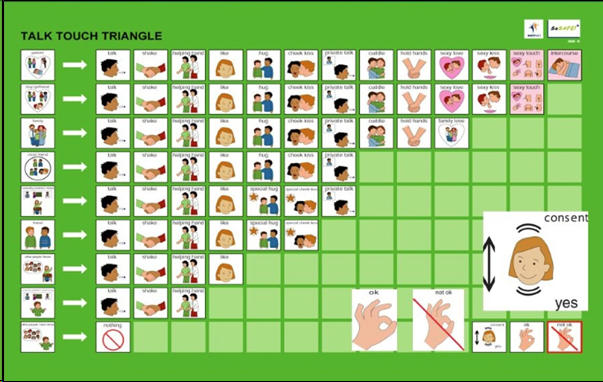
The 'SoSAFE! Program' is a visual teaching tool which enables learners to develop their abilities at managing and communicating about their relationships. The program covers all degrees of interaction; from a student’s expectations of strangers, to the intricacies of an intimate relationship.
Intent
Recognise and accept differences between people.
Understand personal space.
Distinguish between “private” and “public”.
Categorise people and associate social rules for each category.
Understand different types of relationships.
Use behaviour appropriate to relationships.
Keep safe within a relationship.
Know where to seek help or advice.
Implementation
Our RSE curriculum is built upon four levels, based around cognitive abilities, which we take from our 'W-Levels' assessment.
Level 1
Profound and Multiple Learning Disabilities learners (PMLD):
- Sensology
Level 2
Autism Spectrum Disorder (ASD) and Specific Learning Disability (SLD) – W1-W5:
- Sensology
- 1st-5th concepts adapted from SoSAFE!: Stage One
The delivery of these concepts has been modified to suit the ASD cohort as follows:
'OK helpers' are defined as all the people from the student’s class.
- This is to enable the student to ask for help in class when the key worker is absent.
'OK helpers' are labelled twice a day during circle times.
- The students use their Positive Behavioural Support (PBS) book to point to the picture of each 'OK helper', after adult modelling.
'Community Workers' are all the other adults working in school (nurses, therapists etc).
- They are labelled during circle time, if they visit the class during that day. The students use their PBS book to point to the picture of the community worker, after adult modelling.
OK/Not OK concepts are reinforced during sensory or personal care activities.
- The students use their book, or poster (located in the toilet), to answer if it is OK for the adult to proceed with a specific action.
Level 3
W6-W8:
- SoSAFE! Curriculum
- RSE Equals Semi-Formal
In order for our students to stay safe from abuse, form healthy relationships and lead a happy and fulfilling life to the best of their abilities, they need to be able to regulate their own emotions and make the best possible choices. Therefore, learning will be enhanced by discreet sessions focused on:
- Emotional Regulation
- Decision-Making
Level 4
W9 and beyond:
- SoSAFE! Curriculum
In order for our students to stay safe from abuse, form healthy relationships and lead a happy and fulfilling life to the best of their abilities, they need to be able to regulate their own emotions and make the best possible choices. Therefore, learning will be enhanced by discreet sessions focused on:
- Emotional Regulation
- Decision-Making
Impact
The students will make good progress towards their Personal Learning Goals (PLGs).
The students will show love of learning and curiosity.
The students will display contextually appropriate behaviours.
The students will demonstrate improving emotional regulation by expanding their concepts (repetitively labelling the stimuli in a predictable environment).
The students will be more confident, well-rounded, tolerant and more independent by the time they leave Wren Spinney.
Understanding Child Development at Our School
We recognise the importance of supporting children through each stage of their development.
Very young children experience the world in the “here and now.” At this stage, their understanding is rooted in the present moment, and they are not yet able to grasp concepts of the past or future. From around the age of three, children begin to develop a sense of time. They start to distinguish between themselves and the world around them, gradually building an awareness of how they relate to others and to events beyond the immediate moment. As they grow older, children learn to set their own goals, understand their needs, and begin to shape their actions accordingly. They also start to form a sense of purpose, work collaboratively with others, and develop a social identity.
To support this journey, every pupil will have a People and Relationship Book. This resource introduces key concepts, including the Talk Touch Triangle, which helps children explore communication, boundaries, and relationships in a safe and appropriate way.